
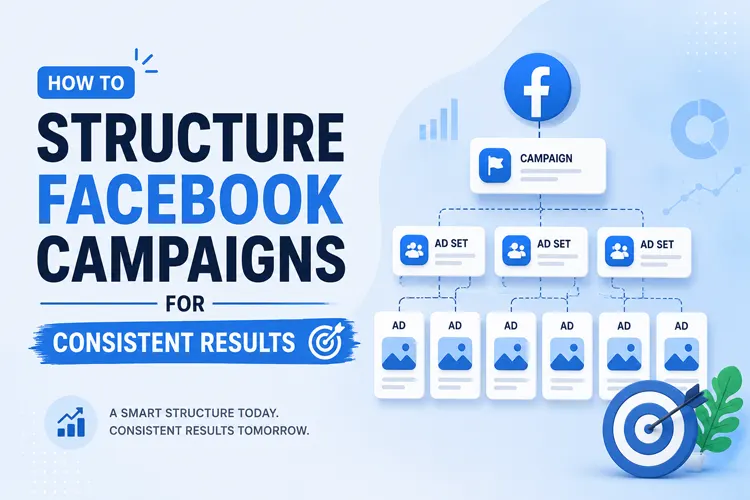


Why Facebook Campaign Performance Can Feel Inconsistent Even With Similar Budgets
A campaign delivers qualified leads at a reasonable cost. The next campaign launches with a similar budget and a comparable offer, yet the outcome looks completely different.
The immediate reaction is often to look at the ad itself. Maybe the creative missed the mark. Maybe the audience was wrong. Maybe the budget needed adjustment.
The problem is not always that obvious.
Results can become difficult to interpret when campaigns are built differently from one another. A change in performance may be linked to the audience, the objective, the budget allocation, or the overall Facebook campaign structure. When several variables shift at the same time, identifying the real cause becomes far more difficult.
That uncertainty creates frustration. Decisions become reactive. Adjustments happen quickly. Confidence in the data starts to weaken because every campaign seems to tell a different story.
Consistent results rarely come from guessing correctly more often. They usually begin with something less visible: campaign consistency, organizational clarity, and a structure that makes performance easier to understand before optimization even begins.
Facebook advertising campaigns generate information every day. The question is whether the way they are organized makes that information useful enough to support better decisions.
Why Campaign Structure Influences Results Before Optimization Begins
Optimization usually receives most of the attention.
Performance drops, costs increase, lead quality changes, and the first instinct is often to adjust something. A new audience gets tested. The budget is moved. Creative is replaced. Another variable enters the equation.
Those decisions become much harder to evaluate when the underlying campaign organization lacks clarity.
A campaign can generate leads, clicks, or conversions and still leave unanswered questions. Which audience responded best? Which message created the result? Which change influenced performance? Clear answers are difficult to find when objectives, audiences, and testing efforts are grouped together without a defined structure.
Performance clarity starts long before optimization. It begins with a Facebook campaign structure that separates decisions in a way that makes outcomes easier to interpret.
Campaign alignment serves a similar purpose. When objectives, audiences, budgets, and messaging follow a logical framework, campaign performance becomes easier to evaluate. The goal is not simply to improve results. The goal is to understand where those results are coming from.
How Campaign Objectives Create Direction for Better Decision-Making
Campaign performance can look disappointing even when the campaign did exactly what it was built to do.
A campaign designed to increase visibility may be criticized for not generating enough leads. Another may collect a healthy number of leads but still be viewed as unsuccessful because the expectation was immediate sales.
The problem is not always performance.
Sometimes the objective and the expectation never matched.
That mismatch creates confusion throughout the campaign. Budget decisions become harder to justify. Results become harder to interpret. Conversations shift toward fixing audiences, creatives, or bids before anyone agrees on what success was supposed to look like in the first place.
Different objectives naturally create different outcomes:
- awareness objectives focus on expanding visibility and reach
- lead generation objectives focus on attracting potential customers
- conversion objectives focus on encouraging a specific action
A clearer Facebook campaign strategy begins with that distinction. Campaigns become easier to organize when the objective shapes the decisions around it rather than becoming something people revisit after the results arrive.
The same principle applies to broader campaign decision-making. Clearer objectives tend to reduce uncertainty because everyone is evaluating performance through the same lens.
How Audience Segmentation Makes Campaign Performance Easier to Understand
Different Audiences Produce Different Behaviors:
Not every audience responds to the same message in the same way.
A campaign may attract strong engagement from existing customers while generating very little interest from new prospects. Another audience may click frequently but rarely convert. Looking at the overall results alone can hide those differences.
Campaign performance becomes easier to interpret when audience groups are evaluated separately. Patterns begin to emerge that would otherwise remain buried inside combined reporting.
Segmentation Supports Cleaner Testing:
Testing becomes difficult when multiple audience types are grouped together.
A strong result may appear promising, yet it can be unclear whether the response came from the audience, the offer, or the message itself. The campaign produces data, but the source of the outcome remains uncertain.
Audience segmentation creates cleaner comparisons. Decisions become easier because fewer variables are competing for credit.
Better Structure Creates Better Learning:
Some Facebook advertising campaigns generate results.
Others generate understanding. The distinction matters.
A campaign may perform well for a period of time and still leave unanswered questions about why it succeeded. Clear audience separation helps reduce that uncertainty by making campaign behavior easier to observe and compare.
Over time, that learning becomes just as valuable as the performance itself. Better decisions tend to follow when campaign structure makes it easier to identify what is actually working.

How Budget Organization Affects Campaign Consistency
Budget discussions often focus on how much money is being spent.
A different question tends to reveal more: where is that budget expected to produce results?
Campaigns can become difficult to manage when resources are distributed without a clear connection to priorities. One initiative is expected to generate leads. Another supports brand visibility. A third is being tested for future growth. The budget is active, but the purpose behind the allocation is less clear.
That lack of structure can create uncertainty during performance reviews. A campaign may consume a significant share of the budget without contributing to the primary objective. Another may show promise but receive limited investment because priorities were never clearly established.
Well-organized budget allocation supports more consistent decision-making by creating clearer boundaries between priorities.
Several factors contribute to that clarity:
- aligned budget priorities
Resources are distributed according to business objectives rather than short-term reactions. - controlled testing
New ideas can be evaluated without disrupting campaigns already producing reliable results. - cleaner performance evaluation
Results become easier to review when spending decisions reflect a defined purpose.
Budget organization does not guarantee stronger advertising performance.
It does make it easier to understand whether performance changes are connected to the campaign itself or to the way resources were allocated around it.
How Structured Testing Produces More Reliable Campaign Insights
A campaign generates leads.
The numbers look encouraging.
The challenge appears during the next campaign when the results are harder to repeat.
Was it the audience? The offer? The creative? The timing?
The previous campaign produced an outcome, but it did not necessarily produce an explanation.
That distinction becomes important during optimization. Decisions are easier to make when there is a clearer understanding of what influenced performance in the first place.
Structured testing helps create that understanding.
When too many variables change at once, campaign management becomes reactive. Performance improves or declines, but the reason remains uncertain. Future decisions start relying on assumptions rather than observations.
Controlled comparisons create a different situation. Individual changes become easier to evaluate because fewer factors are competing for attention. Campaign learning becomes more reliable, and optimization decisions gain stronger support from actual performance patterns.
Reliable insights are not always the result of running more campaigns.
They often come from learning more from the campaigns already running.
Why Complexity Often Creates More Problems Than Performance
Poor results are usually easy to spot.
Operational confusion is not.
A campaign account can look busy and organized on the surface while making performance harder to understand behind the scenes. New campaigns are added. Audiences are duplicated. Objectives overlap. Reporting becomes increasingly difficult to interpret.
The issue is not always the performance itself.
The issue is figuring out what the performance is actually saying.
Complexity tends to create several recurring problems:
- overlapping audiences
Different campaigns compete for attention from similar groups, making audience behavior harder to evaluate. - mixed objectives
Campaigns designed for different outcomes become difficult to compare when success is being measured through multiple expectations. - excessive campaign duplication
Similar campaigns generate additional activity without necessarily creating additional clarity.
Campaign management becomes more difficult when structure expands faster than understanding. More campaigns produce more data, but not always more insight.
A simpler campaign organization often creates a clearer picture of what is working, what is changing, and where decisions should be made next.
How Campaign Structure Supports Consistent Facebook Advertising Performance
Campaign consistency is rarely the result of a single successful campaign.
It develops through a structure that makes decisions easier to repeat, evaluate, and refine over time.
A well-organized campaign may not guarantee stronger results from the beginning. What it often provides is something equally valuable: clarity. Performance changes become easier to investigate. Testing becomes easier to manage. Optimization decisions become easier to justify.
Several benefits tend to build on one another:
- organization improves clarity
A clearer structure makes campaign activity easier to understand and evaluate. - clarity improves optimization
Decisions become more confident when the source of performance changes is easier to identify. - optimization improves consistency
Reliable learning creates a stronger foundation for repeatable results.
Campaign organization should not be viewed as a one-time setup task. Its influence continues long after a campaign launches because every future adjustment relies on the structure already in place.
Performance still needs to be measured. Reviewing relevant campaign performance metrics helps determine whether improvements are creating meaningful business outcomes or simply creating more activity.
Organizations looking to build a more deliberate Facebook campaign strategy often begin by strengthening the foundation behind their campaigns before focusing on additional complexity, budget increases, or expansion efforts.
Better Facebook Campaign Results Begin With Better Organization
Campaigns become easier to manage when the reason behind the results is easier to understand.
A strong month no longer feels like a surprise. A weaker month becomes easier to investigate. Decisions rely less on assumptions because the structure provides a clearer view of what is happening inside the campaign.
That clarity often changes the way performance is approached.
The focus shifts away from constantly searching for the next adjustment and toward building a system that makes adjustments easier to evaluate in the first place.
Consistent results rarely emerge from complexity alone.
They are usually supported by a campaign structure that helps teams learn, adapt, and make decisions with greater confidence over time.